A rep basketball team gets more than six hours a week with a group of 14-year-old boys. Practices, games, car rides, tournament weekends. Few other institutions in a boy’s life get that much time, with that much buy-in, from adults and peers who expect something of him.
Most of that time goes to basketball. That is the job. But every coach also teaches character, whether it is planned or not. A player learns how to handle a mistake by watching how the bench reacts to his. He learns what leadership looks like from whoever talks loudest in the huddle.
This season, my U15 boys team is running that part of the program on purpose. It has a practice plan, a progression and a feedback loop, the same as the jump shot.
The gap
The case for this comes from outside basketball.
Richard Reeves’ Of Boys and Men (2022) lays out a pattern that is hard to unsee once you have read it. On average, boys now trail girls in grades and graduation. Women make up well over half of university students in Canada and the United States. Reeves points to one contributing factor: the parts of the brain that handle planning and impulse control tend to mature a year or two later in boys.
The pattern continues past school. Men report fewer close friendships than they used to. One 2021 U.S. survey found about 15 percent of men said they had no close friends, up from 3 percent in 1990. Men are less likely to ask for help when they are struggling. In Canada, about three in four people who die by suicide are men.
Those are population numbers, not predictions about any individual player. But the direction matters. A 14-year-old is building the habits that carry him into those years right now. School habits. Friendship habits. What he does when something goes wrong.
The cost of ignoring that is not visible on a scoresheet. It shows up years later, somewhere else.
Why a team is the right place
Three things make a basketball team unusually well suited to this work.
Structure. Boys respond to clear expectations, routines and visible progress. A team already runs on all three.
Adults who expect something. A coach is one of the few adults outside the family who sees a player several times a week and holds him to a standard.
Peers. Teammates are the audience that matters most at this age. Lessons that land in front of the group stick.
The time is already there. The only question is whether it is used deliberately.
Treating character like a skill
The design principle is simple. Character gets coached the way any skill gets coached.
Nobody learns a jump shot from a speech. It gets broken into parts, taught, practised in short reps, reviewed, and tested under pressure. Then it gets revisited, because skills decay without reps.
The same structure applies to handling a mistake, asking for help or calling a teammate up to a standard. Each one is a skill with steps. Each one improves with reps.
So the program is built like a practice plan:
- One theme per week, launched Monday and carried through Saturday.
- One small, concrete tool per week that a player can actually use.
- Short daily touches, most of them two to five minutes.
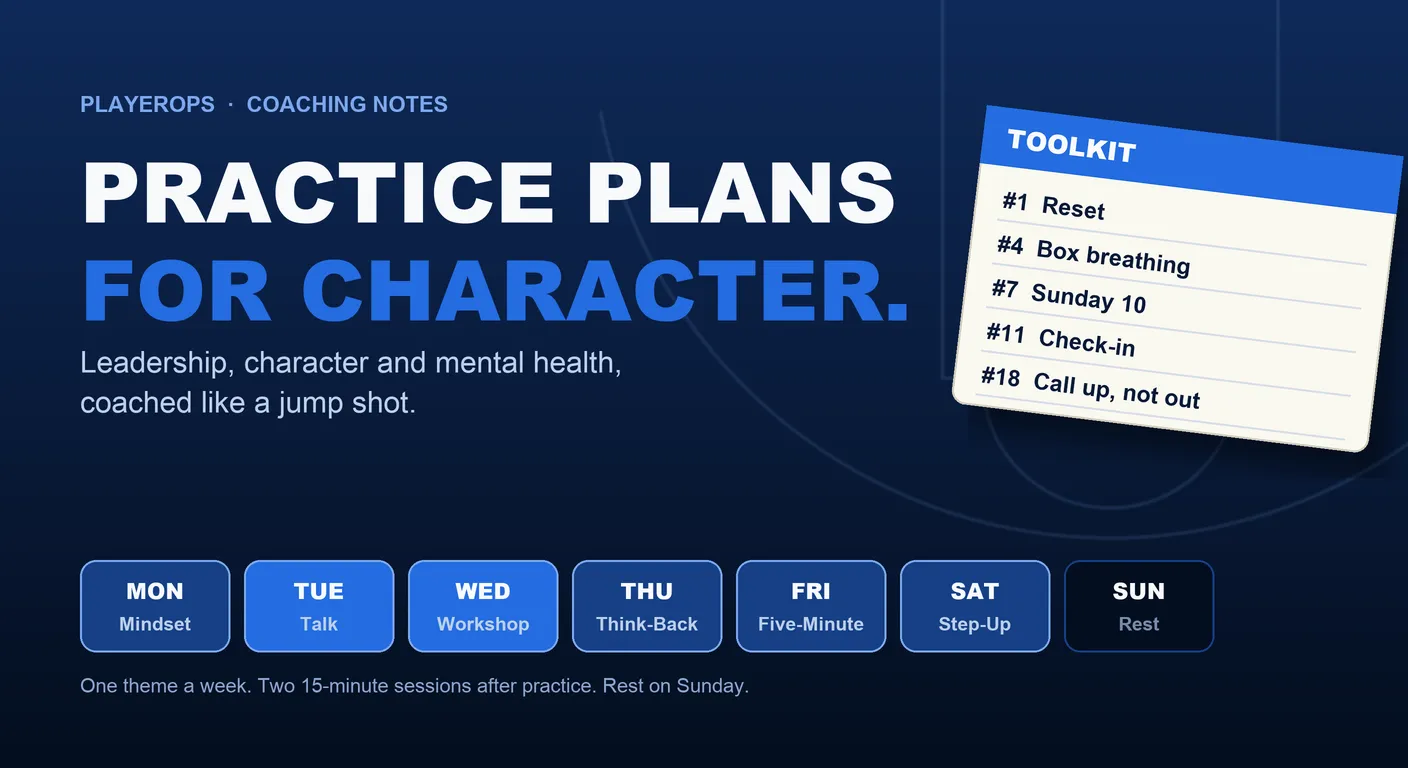
- Two in-person sessions of 15 minutes, after Tuesday and Wednesday practice.
- Spiral review, where earlier tools get rehearsed again in later weeks.
- A feedback loop, so the program changes based on what the players report.
The weekly rhythm
Every day uses a different format. A lecture repeated six times becomes noise. Watching, talking, doing, reflecting, reading and acting each reach a player differently.
| Day | Name | Format |
|---|---|---|
| Monday | Monday Mindset | A short message and a video or quote that launches the week’s theme |
| Tuesday | Team Talk Tuesday | Small-group discussion after practice, 15 minutes |
| Wednesday | Workshop Wednesday | A hands-on session that teaches the week’s tool, 15 minutes |
| Thursday | Think-Back Thursday | A two-minute feedback form |
| Friday | Five-Minute Friday | A short read |
| Saturday | Step-Up Saturday | One small real-world challenge |
| Sunday | Rest | Nothing |
Monday introduces the theme. Every other day adds something new: a story read aloud on Tuesday, a new tool on Wednesday, a new thought on Thursday, a new reading on Friday, a new challenge on Saturday.
The Friday read is deliberate. Literacy is part of the achievement gap Reeves describes. A short, interesting read every week is a small, steady push in the right direction.
Sunday is empty on purpose. Rest is part of the process, and the program should model it.
The in-person sessions
The Tuesday and Wednesday sessions do the most work, so they have the most structure.
Ten players split into three small groups of four, three and three, with experienced and newer players mixed. A basketball serves as the talking piece. Only the player holding it talks. Passing is always allowed.
Tuesday is discussion. The coach reads a short piece to the whole team, then each group works through two questions. A rotating Talk Captain shares one takeaway with the team, without naming who said what.
Wednesday is practice. The week’s tool gets taught in three minutes, rehearsed in groups for eight, and then an older tool gets replayed for three. The last minute goes to writing the new tool down.
Both sessions are timed to the minute. Fifteen minutes is short enough that nobody dreads it, and long enough to get real reps.
The toolkit
Every player carries a small toolkit card in his bag. Each week adds one tool. By May, it holds about 30.
The tools are concrete on purpose. Some examples from the first phase:
- The Reset. One breath, one word (NEXT), one action. Used in the second after a mistake.
- The 3-Second Pause. Count three before answering anything that makes you angry: a call, a comment, a text.
- The Own-It Sentence. “I did ___. Next time I’ll ___.” No “but”, no “because”.
- The Sunday 10. Ten minutes on Sunday to put the week’s assignments, practices and games on paper.
The planning tool is a direct response to the brain-development point in Reeves’ work. If the planning part of a teenage boy’s brain is still catching up, an external system helps more than another reminder to “be more organized”.
The card does two jobs. It makes progress visible, and it gives each player a physical record of tools he chose to keep.
The season arc
The 31 weeks run in four phases, from the inside out.
- Lead yourself (October and November). Mistakes, nerves, self-talk, ownership, habits, sleep.
- Connect (December and January). Friendship, checking in on a teammate, asking for help, stress, phones.
- Lead others (February and early March). Influence without a title, holding teammates to a standard, standing up for someone.
- Purpose and legacy (March to May). Integrity, what kind of man to become, mentors, gratitude, a letter to the future self.
The order is the point. A player cannot lead others until he can manage himself. He cannot hold a teammate accountable until there is enough trust between them for the feedback to land. Each phase builds on the one before it, and many weeks name the earlier tool they extend.
Themes are also timed to the season. Pre-game nerves come the week before the first league games. School planning comes before report cards. Winning and losing comes after the playoffs.
Bringing parents in
The conversations that matter most happen at home, so parents get a short weekly note in their own group chat. It covers the theme, the tool and the challenge, plus one “car-ride question”.
The car works for this because it is side-by-side, not face-to-face. Nobody has to make eye contact, and nobody can leave. Parents are asked to ask the question once, answer it themselves, accept a one-word reply, and keep it separate from talk about the game.
Parents are not asked to check whether anything got done. The note gives them a way into the conversation, not a reason to monitor it.
Guardrails
A coach running a program that touches mental health needs clear limits. These were settled before the first message went out.
This is skill-building, not counselling. Topics are discussed in general terms. Nobody is asked to share something personal in front of the group.
Everything is visible. All messages go through the team’s app, where parents can see them. There are no private messages to players, and a second adult is present for the in-person sessions.
Nothing affects playing time. Participation is encouraged and noticed, never enforced.
There is a referral path. If a player signals that he is not safe, parents are told the same day and the club’s safeguarding process is followed. Kids Help Phone and the 9-8-8 crisis line are posted in the first message and on every Thursday form.
Measuring it
The program needs a feedback loop, or it becomes another thing coaches do because it feels good.
Each Thursday, players answer the same short form. How useful was this week’s theme? What stuck? Which toolkit tool did you use, and where? What should we talk about next?
Once a month, the form adds a short pulse check:
- “I feel like I belong on this team.” (1 to 5)
- “I know who I could talk to if I was struggling.” (yes or no)
- “One thing I’ve done differently because of this program.”
At the end of the season, players and parents get a short survey. What worked stays. What did not gets cut.
It is week one. There are no results to report yet. The signal will come from those Thursday forms, and from whether the tools start showing up unprompted: a player saying NEXT after a turnover, or a teammate checking in on someone who is having a bad day.
The lesson
The skills that decide how these boys do in school, in friendships and in hard moments are learnable. They respond to the same things a jump shot responds to: clear teaching, short reps, review and feedback.
Most teams already have the time. What is usually missing is the plan.
Run your club on one platform. PlayerOps handles tryouts, roster, schedule, and parent comms so you can focus on coaching. Start your club →